A prime pairing, certainly. (Tripping with Elmo is also recommended for anyone who thinks a foul-mouthed reincarnation of the furry fellow isn't sacrilege- it'll also solidify no Leary-like fun times for all you fence sitters).
It is from this tenuous thread linking the power of the mind to the engineering of consent that we will discuss the BBC Doc: Century of the Self. Don't let the title mislead you as it's a compelling and rich film. If you've not yet succumb to compassion fatigue- well then this will piss you right off. Which can be a great thing especially for your wallet!
Skeptics hear me out; this is no conspiracy theory nonsense as the examples will illustrate that spin, PR, and advertisement by corporations and the government in the modern age = expressly reprehensible.
Preamble: the unconscious self (now known as automatic or subliminal processing) was theorized by Freud to be those desires and impulses animalistic in nature that all humans possess. These 'dangerous' needs are pushed down beneath the surface of consciousness through various processes called defense mechanisms (denial, repression, etc.). Many claim that the extent to which the subconscious reptilian brain influences behaviour is far beyond that of the rational self, which is surprisingly not a popular sentiment amongst the general population as we all would like to consider ourselves rational, logical beings...we put people in space, n'est-ce pas?
Courtesy of WIKI!:
The business and, increasingly, the political world uses psychological techniques to read and fulfill our desires, to make their products or speeches as pleasing as possible to us. The film raises the question of the intentions and roots of this fact. Where once the political process was about engaging people's rational, conscious minds, as well as facilitating their needs as a society, the documentary shows how by employing the tactics of psychoanalysis, politicians appeal to irrational, primitive impulses that have little apparent bearing on issues outside of the narrow self-interest of a consumer population.
Paul Mazer, a Wall Street banker working for Lehman Brothers in the 1930s said, "We must shift America from a needs- to a desires-culture. People must be trained to desire, to want new things, even before the old have been entirely consumed. [...] Man's desires must overshadow his needs."

This morally repugnant pug-man was hired by Pres. Woodrow Wilson to promote America's aims during the War to the world, whereby the US was made to be seen as The Liberator, bringing democracy to all of Europe. He was wildly successful and started to wonder whether a smiliar brand of mass persuasion could be brought about during peace time. Millions of people flocked to the city and control of this mass industrial society was of utmost importance. Bernays saw this need and knew he could make a buck off of corporations and the government alike.
He rightly believed that 'propaganda' had been given a bum rap from the Germans and thus came up with a new term: Public Relations.

His first dalliance with PR events was when he managed to play to the irrational emotions of the masses by having 5 debutantes dramatically light up cigarettes at an event where suffragettes were protesting for freedom and liberty. All the symbolic nuances involving liberty, justice, freedom and liberty was not lost on the public who lapped up the idea that smoking was merely affirming women's independence whereas just a few moments earlier it had been strictly taboo.
Product soon became used as a projection of the self and by purchasing a material good, one could improve one's mood. This is the fundamental part: that it became accepted that emotions could be intrinsically tied to the purchase of a desired object.

After the war corporations were worried that they might start overproducing as people were still mainly only buying on basis of need. Product was sold on the basis of necessity with function and durability front and center in adverts. People were soon molded to believe that one could express one's self via their material belongings.
Bernays had Pres. Coolige flanked by celebrities at the first ever joint initiative of public relations and the government: the photo opportunity in an attempt to change his public persona of being dull.
Strategies for social control became his raison d'etre and believed he could elicit desires by stimulating unconscious and then placating with product thereby rendering the public docile. The engineering of consent acted as an opiate for the masses.
Pres. Hoover believed that consumerism had to become the center of American life as it was the key to economic progress. The happiness at all times doctrine allowed consumers to be content without ever requiring an alteration of objective circumstance. This was required as a means of preserving power dynamics as Bernays truly believed that humans were 'stupid dopes'.
For a brief period PR fell from fame with the collapse of the market in 1929 bringing about mass social change and a taste for blood on the lips of all citizens for those believed to have caused the depression: the corporations.
Before the Nazi Germany there were 32 parties. Selfish individualism was unleashed and there were no means to control it. Soon however, with the rise of Hitler, a new united front allowed for a transformation of all unrest. The self was channeled into service in the name of a united nation. Goebels said they had forged individual thinking, feeling and desire into a new sense of oneness. The libidinal (love) forces had been granted to their Fuher and all the accompanying aggression funneled into hatred of the out group. People who had once been exceedingly restrained and private screamed en masse.

Back in America, Roosevelt was re-elected with the success of the New Deal and the corporations banded together to plot out how they could rise above this crisis. They formed the National Association of Manufacturers, still present today, who planned ideological warfare against the New Deal. They hired Bernays to show Americans that it was in fact business and not individual politicians or the people who had formed America. The campaign involved billboards, newspapers in the first manipulations of the press. The World's Fair also allowed further opportunity to embed the belief that Democracy and Capitalism were forever wed - where progress and the American Dream were synonymous and to not endorse this belief, one was inhibiting individual freedom- the greatest sin.
WWII gave credence to Freud's theories. 49% of soldiers were evacuated from combat due to mental problems. Officials turned to psychoanalysis for a solution. Psychoanalysts believed combat had triggered repressed childhood memories. The analysts never questioned reality- that the situation itself could be the source of "evil" and should be questioned.
The Institute of Motivational Research was established to uncover the secret self of the American consumer. Focus groups discussed product and were in essence, group therapy. It was here that things that were not or could not be verbalized by the conscious were probed. For instance, with the introduction of convenience foods by Betty Crocker, it was uncovered that an unconscious guilt regarding housewives' use of things like instant cake mix needed to be overridden. By adding an egg, a greater sense of participation was felt and sale skyrocketed.
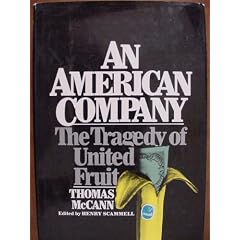
In the middle of McCarthyism, Bernays, hired by the directors of United Fruit, played a pivotal role in convincing the US government that Colonel Arbenz of Guatemala was secretly Communist, thus contributing to the CIA's decision to assist in overthrowing Arbenz's government in 1954- allowing for the banana republic to resume business as usual. The term 'banana republic' actually originated in reference to United Fruit's domination of corrupt governments in Guatemala and other Central American countries. The company brutally exploited virtual slave labor in order to produce cheap bananas for the lucrative U.S. market.
Marcuso agreed with Miller in that materialism had nothing to do with tangible change and that the production of innumerable unwanted products leads to empty prosperity and will simply erupt. The idea that people need to be controlled is wrong and that it is in fact society that makes drives dangerous by repressing them, making people more susceptible to corruption, evil and corrupting.
How is this relevant today? In looking at Capitalism and its place in the minds of Libertarians, it has everything to do with this confabulated fabrication of the link between Freedom and Capitalism.
Another damning case against the free market approach is the misapplication of Game Theory. John Nash, the guy Russel Crowe played in a Beautiful Mind came up with the "fuck you buddy" Game Theory of behavioural economics that would eventually win him the Nobel Prize. He believed humans were inherently suspicious and manipulating and calculating (dis-confirmed through cross-cultural research - basically research not done on middle to upper class white Americans). He later admitted he was overly suspicious and views of humans were false- as he was a paranoid schizophrenic! Game theory was used to create the US's nuclear strategy during the Cold War. Because no massive nuclear fallout occurred, it was believed that game theory had been correct in dictating the creation and maintenance of a massive American nuclear arsenal—because the "Commies" had not attacked America with its nuclear weapons, the supposed deterrent must have worked (misattribution).

The point of all that wasn't to air a jeremiad- I'd run the risk of sounding like Marky Mark in I Heart Huckabees.

So in keeping with keepin things positive here is a list of things we could do instead of purchasing masses of unfulfilling junk at the season of peak Consumerism:

-Bake up a batch of sweetness to disperse to those in need (homeless persons, carolers, poor grad-students)
-Write a long-ass letter telling someone how much they mean to you in prose form- or free form poetry is also a hit
-Record a series of Garage Band raps on a mix CD or TAPE!
-Make up a hamper for a family in need - honestly one of my best Holiday memories
-If you're not crafty (I'm certain one cannot be less so than I): hire someone who is like your friend with incredible pottery/sketching/photography/bedazzling talents would appreciate the biznaz
Studies show that those things that involve doing something provide longer lasting effects (good memories) vs. material good.
Well that was a lonnnnng one and if you've made it thus far...props to your staying power!


